Last Updated: July 8, 2026 Reading Time: 8 min
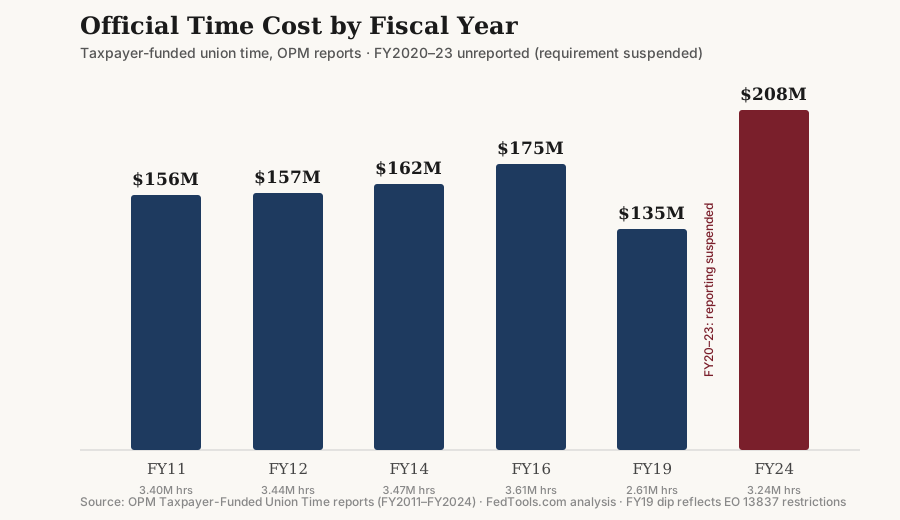
One number is driving the newest fight over federal unions: $207.5 million. That is what OPM says taxpayer-funded "official time" cost in FY2024, up 54% from FY2019, and the report's July republication landed in the middle of an administration campaign that has already terminated union contracts covering hundreds of thousands of employees. Here is what official time actually is, what the numbers really show, and what the 1.38 million represented feds stand to lose.
What Official Time Actually Is
Official time is paid duty time that employee union representatives spend on representational work instead of their regular jobs. Congress created it in the 1978 Civil Service Reform Act, codified at 5 U.S.C. 7131, as part of a deliberate trade: federal unions cannot charge mandatory agency fees the way private unions can, but they must represent every employee in the bargaining unit, dues-payer or not. Official time is the mechanism that makes that duty-to-represent workable.
The statute splits it into four buckets:
| Provision | Covers | Status |
|---|---|---|
| 7131(a) | Negotiating the union contract | Statutory right, cannot be zeroed out without Congress |
| 7131(b) | Internal union business (recruiting, dues, elections) | Explicitly prohibited on official time |
| 7131(c) | FLRA proceedings | Authorized by regulation |
| 7131(d) | General labor-management work, including grievances | Negotiated amount, most vulnerable |
That second row is the most misunderstood fact in the debate. Soliciting members, running union elections, and collecting dues have never been legal uses of official time. What the money actually buys is mostly grievance handling, arbitration prep, safety committee work, and contract negotiation. NTEU members should separately note the dues direct-deposit deadline in September 2026, which is unrelated to official time.
What the $207 Million Really Shows
The FY2024 report is the first full accounting since FY2019, because the reporting requirement was suspended for four years. The headline comparison, $135 million to $207.5 million, is real, but the composition matters:
- Hours rose 24% (2.61 million to 3.24 million), returning to roughly the FY2011-2016 range after the 2018 executive-order crackdown pushed them down. FY2024's 3.24 million hours are still below FY2016's 3.61 million.
- The cost per hour rose 24% (about $51.72 to $64.05), tracking federal salary and benefit growth. Compounded, those two effects produce the 54% cost jump.
A few FedTools calculations to put $207.5 million in scale:
- Per represented employee: about $150 per year across the ~1.38 million bargaining unit employees OPM counts. (The often-cited "700,000" figure is dues-paying members; unions must represent the full 1.38 million.)
- In positions: 3.24 million hours equals about 1,558 full-time employees, spread across a 2.1-million-person workforce.
- Per working day: roughly $798,000.
Add OPM's companion report on collective bargaining expenses ($181.6 million) and the full FY2024 labor-relations bill comes to about $389 million.
Why This Is Surfacing Now
The republished report is ammunition in a fight that is already well underway:
- March 2025: EO 14251 stripped collective bargaining rights from agencies designated as having national security missions, roughly 40 agencies. EO 14343 expanded the list in August 2025.
- April 2026: Defense Secretary Hegseth ordered termination of most DOD collective bargaining agreements, covering about 300,000 civilian employees. Official time at DOD largely stopped with the contracts.
- July 6, 2026: Unions filed suit in federal court in Maryland challenging the DOD terminations.
- In Congress: the "No Union Time on the Taxpayer's Dime Act" would abolish official time outright. It has not passed, and 7131(a) negotiation time cannot be eliminated without it.
If you work at DOD or one of the EO-covered agencies, this is not hypothetical. Our DOD union contract termination survival guide covers what changes when your CBA disappears, and the AFGE/NFFE lawsuit brief tracks the litigation.
What Employees Lose If Official Time Goes
The direct users of official time are a few thousand union reps. The indirect users are every one of the 1.38 million employees in a bargaining unit, because representation capacity is what official time buys:
- Grievance speed. A steward with negotiated official time can investigate your case during duty hours. Without it, your grievance waits for someone's lunch break or a national office staffer with a hundred other cases.
- Arbitration and appeals. Contract enforcement runs on rep hours. Fewer hours means unions triage harder, and marginal cases get dropped.
- Negotiated protections themselves. Term negotiations under 7131(a) survive, but an agency that has terminated its CBA has nothing to negotiate against, which is the DOD situation now being litigated.
Whatever your view of unions, know your own exposure: if your pay, schedule, telework, or discipline procedures live in a CBA, the machinery that enforces them is what this fight is about. Your union status does not change your paycheck math, but a lost locality provision or schedule right can. Run your numbers on the GS Pay Calculator if a workplace change is on the table for your agency.
Calculate Your Pay
Use the free GS Pay Calculator to see your 2026 salary with locality pay, and model how a grade or step change moves it. Try it now →
Frequently Asked Questions
What is official time?
Paid duty time that federal-employee union representatives spend on representational work: contract negotiations, grievances, arbitrations, and FLRA proceedings. It comes from 5 U.S.C. 7131. Internal union business like recruiting and dues collection is explicitly barred from official time.
How much official time did federal unions use in FY2024?
About 3.24 million hours costing $207.5 million, per OPM. That is a 54% cost increase over FY2019, driven mostly by higher federal compensation rates; the hours themselves remain below the FY2016 peak of 3.61 million.
Can the president eliminate official time?
Only partly. The 7131(a) right to official time for contract negotiations is statutory, so full elimination takes an act of Congress. Executive orders and CBA terminations can and do gut the negotiated 7131(d) category, which covers most grievance-handling time.
Why do taxpayers fund union time at all?
It is the trade Congress built in 1978: federal unions cannot collect mandatory fees, but they must represent every bargaining unit employee, member or not. Official time compensates the representation duty the law imposes.
Does official time affect me if I'm not a union member?
Yes, if you are in a bargaining unit. About 1.38 million employees are covered by union contracts, and unions are legally required to represent all of them. The steward who would handle your grievance is likely working on official time.
Related Resources
- DOD Union Contract Termination Survival Guide: What changes when your CBA is terminated
- AFGE/NFFE v. DOD Bargaining Lawsuit: The July court challenge to the contract terminations
- GS Pay Calculator: Your 2026 salary with locality pay
Sources: OPM FY2024 Taxpayer-Funded Union Time report, 5 U.S.C. 7131 (Cornell LII), FedSmith, Federal News Network